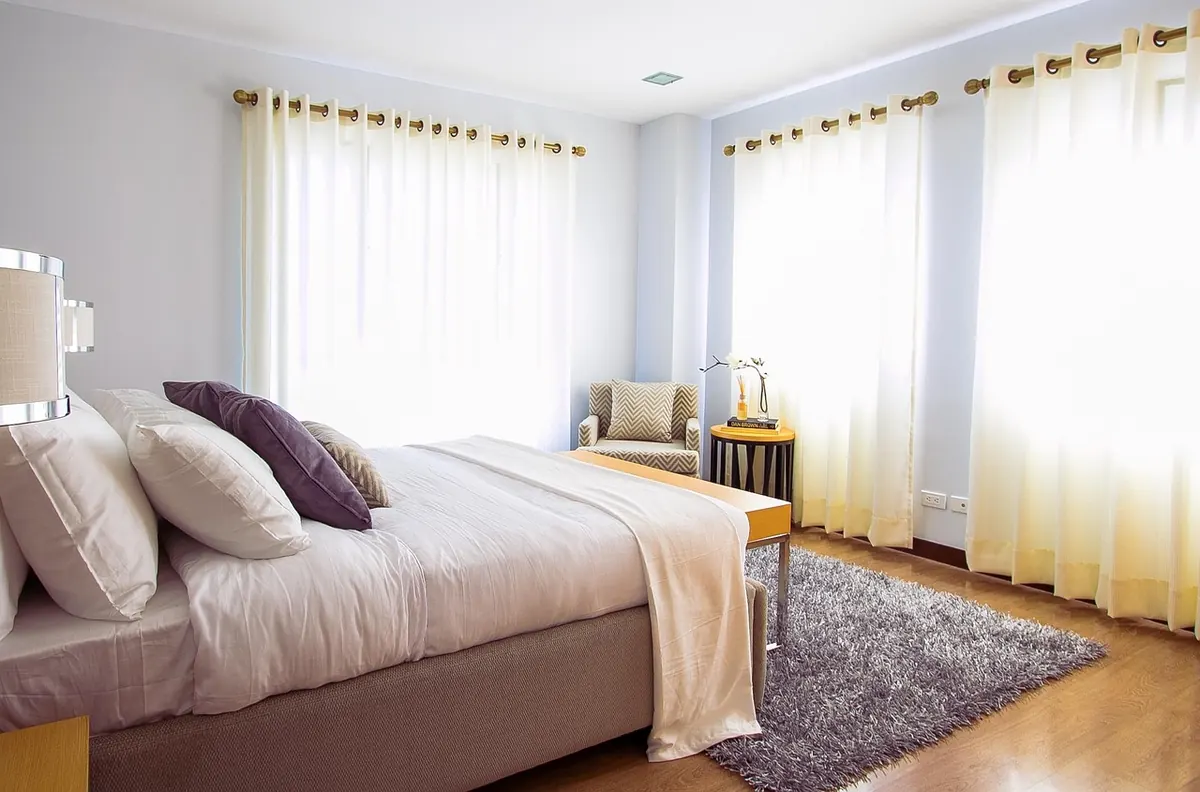
A farmhouse window is rarely a perfect rectangle. The walls have had a century or two to settle, the plaster is thicker at one end of the reveal than the other, and the sill has a lean you notice only when you lay a level against it. None of that is a fault. It is exactly why a well-hung curtain suits these houses so well. But it does mean the measuring has to be done differently from the way you would measure a new window in a new building. Work through the steps below in order, and you will finish with a set of numbers you can order from with confidence.
What to Have Beside You
Measuring an old window properly takes about twenty minutes per window, most of it spent taking the same measurement in three places. Clear the sill, take the old curtains down, and keep them somewhere within reach until the new pair is actually hanging.
- A steel tape measure, 3 m at minimum, 5 m if the ceilings are high
- A pencil and a notebook
- Masking tape for marking bracket positions
- A spirit level, the longest one you own
- A straight edge — a length of timber, a metre rule, a broom handle
- A small step ladder, so you are not estimating from the floor
Write every number in centimetres and note the unit on the page. Mixing centimetres and inches, or writing “120” with no indication of what it means, is the most common reason a made-to-measure curtain arrives the wrong size. Get into the habit of noting width first and drop second, in that order, because that is how most makers will ask for it.
Inside the Recess, or Across the Wall?
Farmhouse walls are thick. The reveal can run 25, 30, sometimes 40 cm before you reach the frame, and that depth decides almost everything about how a curtain should hang.
Inside the recess keeps the curtain contained. It suits small rooms, short cottage-style curtains, and windows where furniture crowds the wall on both sides. It only works if there is clear depth for the bracket plus the folded fabric — roughly 10 cm or more — and if nothing else needs that space. Interior shutters are the usual obstacle: they fold back into the reveal, and a curtain hung inside will block them.
Across the wall buys you height and tidiness. A pole or track set above the opening hides a crooked frame, makes a low room feel taller and allows a full-length curtain that falls in one clean line. It uses more fabric, and it needs a wall you can fix into. On a lumpy stone wall, the pole will sit away from the plaster at one end unless you pack the brackets out.
A workable rule: if the recess is deeper than about 15 cm and there are no shutters, hanging inside looks neat and traditional. If the opening is visibly out of square, or you want floor-length curtains, go across the wall.
Measuring Inside a Deep Recess
Three widths and three drops, every time. The reason is simple: on an old window, the top of the reveal and the bottom are rarely the same width.
- Measure the width at the top of the recess, in the middle and just above the sill. Write all three down.
- Ignore the widest figure. The narrowest is your working width; take 1 cm off each side so the fabric does not rub against the plaster.
- Decide the height of the track or pole. Inside a recess this is usually 8–10 cm above the top of the opening, or at the ceiling of the recess if it is shallow.
- Measure the drop from the underside of the pole or track to where the hem should finish: 1–2 cm above the sill, 10–15 cm below it, or 1–2 cm above the floor.
- Repeat that drop on the left, in the centre and on the right.
- Look for anything the fabric will touch — shutter hinges, projecting window handles, a tilting sill, a radiator tucked underneath.
Say the recess measures 118 cm at the top, 116 cm in the middle and 119 cm at the bottom. The working width is 116 cm, minus 2 cm of clearance, so 114 cm. The drop measures 141 cm on the left, 144 cm in the centre and 142 cm on the right. For a floor-length curtain, order to 141 cm and accept a slightly wider gap at the centre than at the ends. A hem that hangs level and clears the floor looks far better than one that is perfect in the middle and puddles in a corner.
Measuring for a Pole or Track on the Wall
The usual allowance is 15–20 cm beyond the window opening on each side, with more generous margins on very wide windows, and the pole set 10–15 cm above the top of the opening. If the ceiling permits, going higher still — up to just below a cornice or beam — is what gives an old room its sense of height.
Measure between the bracket centres, not the full length of the pole. Mark both positions with masking tape and measure between the tapes; those same marks will tell you where to drill later. Remember that finials add length at each end, and that the curtains hang inside them, not over them.
For the drop, hook the tape on the ring or the runner rather than the pole itself, because the fabric hangs from the hook. Then measure to the floor at three points across the opening. Old floors slope, and 2–3 cm across a window is not unusual.
When Nothing Is Level or Square
Old houses are honest: nothing is plumb, and everything is still standing. You are not trying to correct the wall, only to make sure the curtain hangs straight in front of it.
Check the opening for square by measuring both diagonals from corner to corner. If the figures differ, the frame is out of true, and a curtain hung to the frame will look crooked even when it is perfectly made. Hang it to a plumb line instead, and let the window be slightly askew behind it.
Photo: Pexels / Pixabay