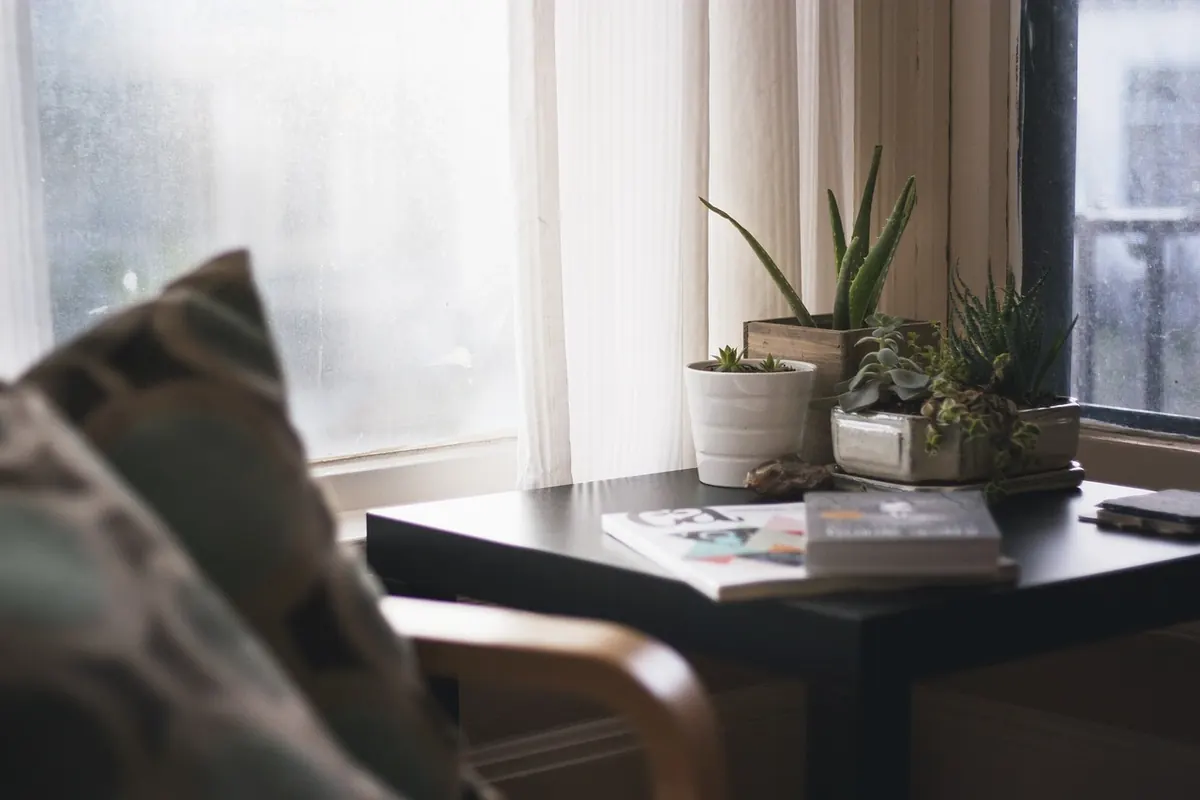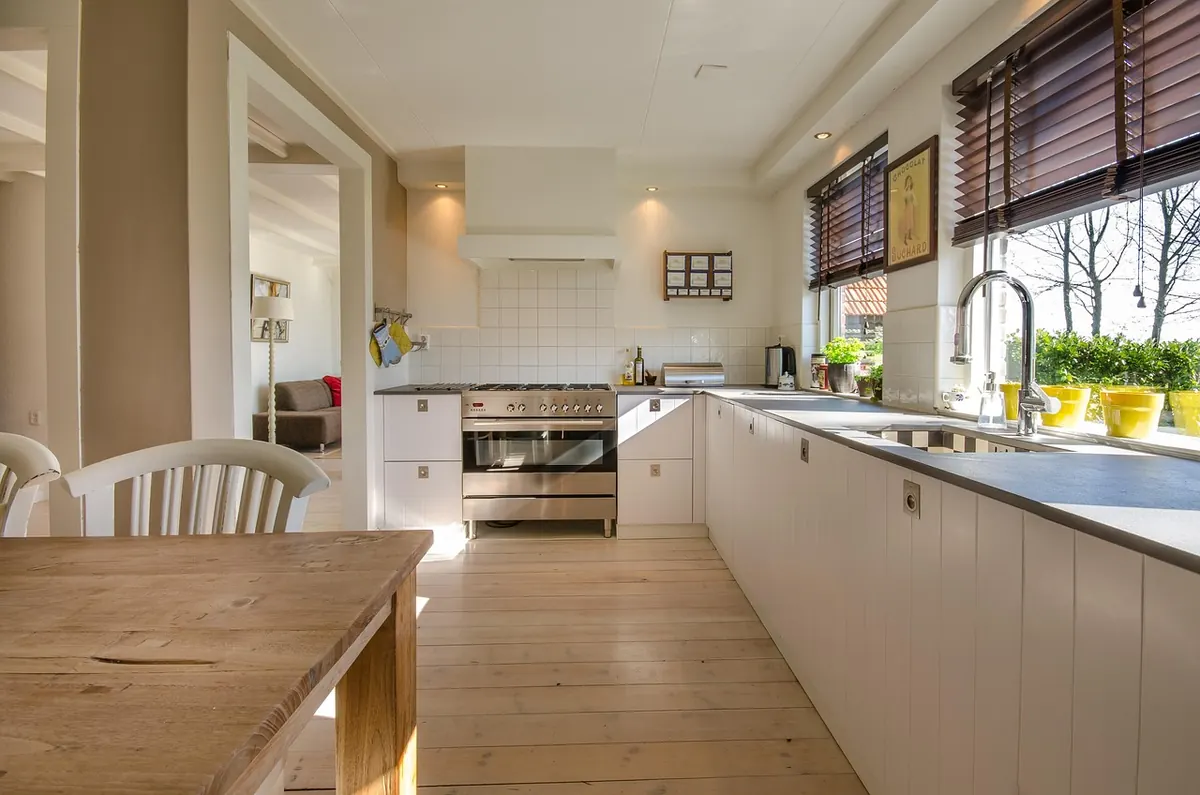
A cottage window is rarely a plain rectangle. There is the deep whitewashed reveal, the lintel that sits a finger out of level, the small-paned casement that swings inward, the sill wide enough for a jug and a pair of muddy boots. Whatever you hang there has to work with all of that — and with the fact that in a low-ceilinged room, the window is often the brightest and most important piece of architecture you own.
Roman blinds and roller blinds do the same basic job: one panel of fabric that lifts and drops. In a cottage they behave very differently. One brings folds, softness and a little theatre. The other brings tidiness and gives you back your glass. Here is how they compare on the things that actually matter.
The Look: Folds, Texture and Clean Lines
A Roman blind is a length of fabric with horizontal rods sewn into pockets, so it gathers into soft horizontal folds as it rises. In a cottage that reads as generous. Washed linen in oatmeal, a red ticking stripe, a faded sprig print, a wool mix in moss green — these sit happily against lime plaster and old beams. Down, the blind hangs in a quiet column of folds. Up, a stack of fabric rests at the head of the window like a small, soft pelmet.
A roller blind is a taut sheet of fabric on a tube, and that tautness is the whole point. In a plain linen weave or a chalky off-white it almost disappears: it does the job and steps back. The risk in a cottage is that a crisp, flat rectangle of strong colour looks a little municipal against old walls, especially in a glossy or busy print. Choose a matte fabric with visible texture — a slubby weave, a subtle herringbone — and the problem vanishes.
Where each one wins
If the window is a feature — a wide stone mullion, a pair of casements framing the garden — a Roman blind gives it a frame. If the window is one of a row, sits behind a sofa, or you already have curtains and want something modest behind them, a roller keeps the peace.
Operation: How Much Glass Do You Lose?
This is the question most people forget until the blind is up. A Roman blind, raised, keeps roughly the depth of its fold stack at the top of the window — often 15 to 25cm depending on how many folds you choose. On a small cottage casement, that is a real slice of daylight gone for good. A roller rolls away to a tube, or hides inside a slim cassette, so you lose very little.
Control is different too. A chain-operated roller moves smoothly and stops exactly where you let go, which makes it easy to set at half height for a spring afternoon. Roman blinds use cords, a chain, or a cordless tension system; wider blinds have two or more cords that need to be pulled evenly, and a little patience, or the blind hangs slightly crooked. Cord loops should always be kept short and cleated well out of reach of children and pets, and cordless or tension systems are the safer choice in a house with small children.
One small pleasure worth noting: a Roman blind left halfway down makes a lovely deep valance of folds. A roller left halfway looks like a roller left halfway.
Light Control and Privacy
Lined Roman blinds filter light beautifully. The fabric softens a hard southern glare into something you can sit in, and a blackout lining turns one into a proper bedroom blind. Because the fabric hangs in folds, light creeps around the sides rather than through the cloth, so a face-fixed Roman with a generous overlap gives better darkness than an inside-recess fitting.
Roller blinds are more clinical about light: a crisp edge, a bright room, and a visible glow around the sides and top unless you fit them outside the recess. For a bedroom that needs to be dark at six in the morning, a face-fixed blackout roller works well. For a sitting room, a sheer unlined Roman in a voile or open-weave linen gives daytime privacy on a lane-facing window without turning the room into a cave — and it looks considerably softer than a sheer roller.
Fitting an Awkward Cottage Window
Old windows are where the two blinds genuinely part company. Before you order anything, work through this:
- Reveal depth. A deep stone reveal can swallow a Roman blind; there is nowhere for the fold stack to sit, and the fabric chafes against the plaster. Rollers cope better inside a recess but show every out-of-square gap.
- Wall surface. Lime plaster over lath, rubble stone and old brick are all unforgiving. A Roman hangs from a timber batten screwed across the head, which bridges an uneven lintel neatly. Roller brackets must be level, or the blind runs crooked; pack them with washers until they are.
- Opening direction. Inward-opening casements need clearance, so the blind must sit clear of the swing — usually face-fixed above the frame.
- Obstructions. Window handles, a deep window board, a radiator beneath the sill. Measure the drop with all of them in mind, and check the bottom of a Roman clears the sill rather than resting on it.
Fabric, Damp and Everyday Life
An old cottage is a damp-ish, draughty, living thing, and fabric near glass will collect condensation. Keep either blind a couple of centimetres clear of the pane so air can move, and wipe the glass in cold weather rather than letting moisture sit against the cloth.
In a kitchen or bathroom, a roller in a coated or wipeable fabric is the practical answer: steam beads on it, food splashes wipe off, and it recovers its shape. Linen Romans near a shower will cockle, spot and eventually stain. If you want the Roman look in a bathroom, choose a washable cotton-blend or a purpose-made moisture-resistant fabric, and keep it clear of the splash zone. In a sitting room or bedroom, an interlined Roman adds a useful layer against draughts — though the extra bulk makes the fold stack deeper.
Care and How They Age
Roman blinds collect dust along the top edge of every fold. Vacuum them monthly on low with a brush attachment, and they will stay fresh for years. Cords stretch, folds relax and the blind eventually hangs a little longer than when it was new; both can be adjusted, and the fabric can often be re-covered onto the original mechanism. Press the fabric gently when it comes back from cleaning, but do not iron the folds flat — they are the point.
Rollers need less attention: a wipe with a damp cloth and a little mild soap. Their weaknesses are the bottom edge curling, a wide blind developing a gentle wave, and springs softening on cheaper spring-roller models. Rollers are generally the less expensive option, and replacing one outright is usually simpler than repairing it.
Choosing for Your Own Window
- Stand in the room at the hour you use it most. Morning sun and evening lamplight ask different things of a window.
- Measure the glass height and the reveal depth, then subtract the fold stack. If the window is small, a Roman may cost you more light than you want to give.
- Decide whether the blind is the star or the support act. Curtains plus blind usually means a roller; a bare window with one dressing means a Roman.
- Match the fabric to the room's moisture, not just its palette.
- Check the fixing surface and the clearance for handles before you order, not after.
In most cottages the honest answer is both. A Roman in the sitting room and bedrooms, where softness and texture are doing real work; a roller in the kitchen, bathroom and boot room, where a damp cloth and a clean line matter more. Choose each window on its own terms and the house will look as though it was never any other way.
Photo: ClickerHappy / Pixabay